CBSE Board 2026: The Dawn of On-Screen Marking (OSM) for Class 12 Evaluation
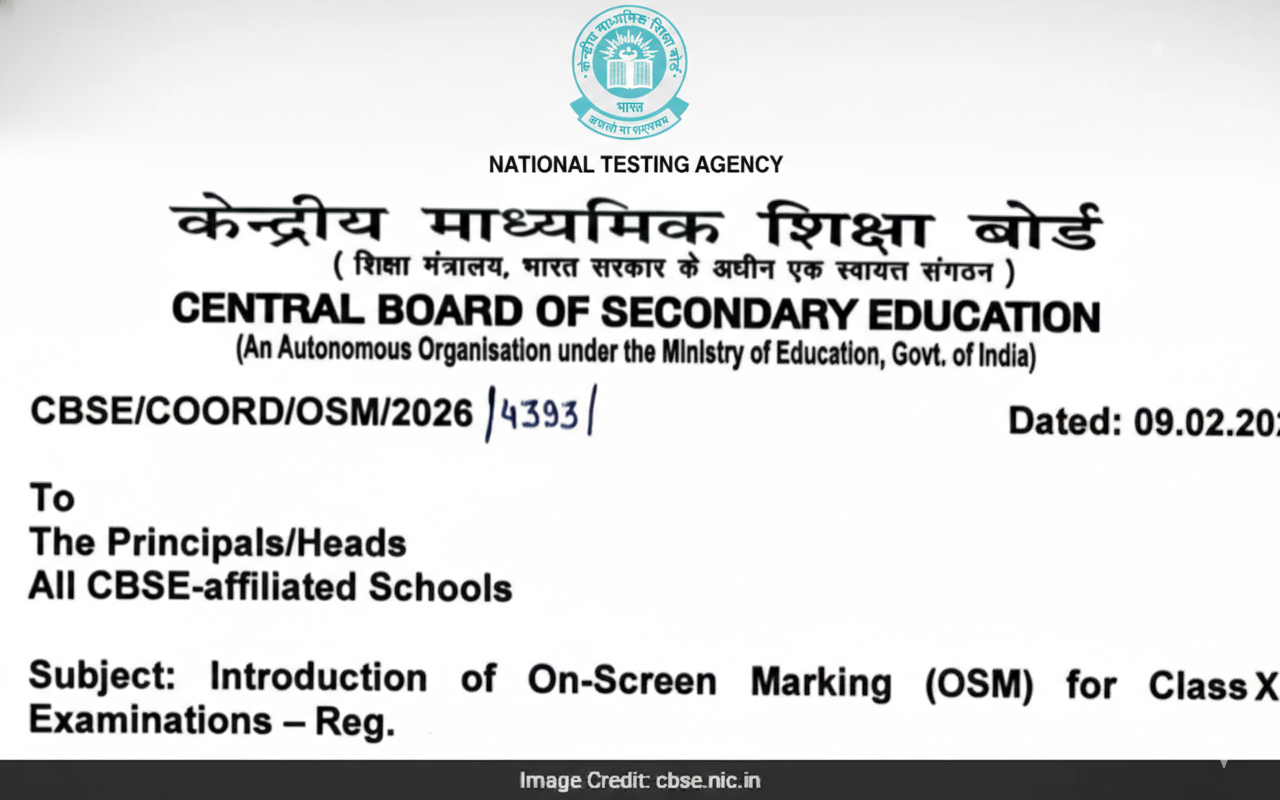
The Central Board of Secondary Education (CBSE) has officially initiated a structural reform in its evaluation ecosystem for the 2026 Board Examinations. For the first time in its history, the board has moved away from traditional manual checking of paper booklets to a fully digital "On-Screen Marking" (OSM) system for Class 12 candidates. This shift, announced via an official circular on February 9, 2026, is designed to eliminate human errors in totalling, speed up result declaration, and bring unprecedented transparency to the marking process. While Class 10 evaluation remains physical for this cycle, the digital leap for senior secondary students signals a new era in Indian academic assessment.
What is On-Screen Marking (OSM)?
On-Screen Marking is a digital evaluation framework where physical answer scripts are converted into high-security electronic images immediately after the examination. Instead of handling physical bundles of paper, evaluators log into a secure, centralized portal using their OASIS credentials to assess these scanned copies on a computer screen. The software is equipped with specialized tools for annotation, step-wise marking, and automatic calculation. This ensures that no question is left ungraded and every mark awarded is instantly recorded on the CBSE servers, removing the risk of logistical loss or manual calculation mistakes.
The scale of this operation is staggering. For the 2026 cycle, CBSE expects to process over 1 crore answer booklets for nearly 18.6 lakh Class 12 students. By digitizing this volume, the board aims to shorten the evaluation cycle from the traditional 12 days to just 9 days, potentially leading to earlier result announcements. This is particularly crucial for students planning to appear for entrance exams like CUET, where early scorecards facilitate smoother university admissions.
[Image: Flowchart of CBSE OSM process from Answer Sheet Scanning to Digital Award of Marks]Eliminating Post-Result Verification Anxiety
One of the most consequential changes accompanying OSM is the expected discontinuation of post-result mark verification. In previous years, thousands of students applied for re-totalling due to clerical errors. With the digital system automatically calculating totals and flagging any ungraded sections, the board claims that numerical discrepancies will be eliminated at the source. This move is intended to reduce student anxiety and administrative burdens, making the declared result final and reliable from the outset.
However, this puts the onus on students to ensure their handwriting and presentation are optimized for scanning. CBSE has advised students to use darker pens and maintain clear spacing between answers. fAint pencil work on diagrams and excessive use of whiteners are discouraged, as they can lead to blurry digital images that are difficult for examiners to read on-screen. For aspirants focusing on top-tier colleges, the clarity of their responses now has a direct impact on the ease of their evaluation.
The Impact on Competitive Prep and Results
For the cuet.pro community, the faster evaluation of Class 12 results is a strategic advantage. Early board results allow for a more focused approach to CUET domain preparation, as students can quickly pivot from boards to the entrance mindset with their academic performance already secured. Furthermore, the transparency of OSM provides a fairer playing field, ensuring that the hard-earned marks of students in Science, Commerce, and Humanities are recorded with mathematical precision.
- Totalling errors are mathematically eliminated by the OSM software.
- Faster results enable earlier college application cycles.
- Transparency is increased with a digital audit trail of every marking decision.
- Wider participation of expert teachers, including those from overseas affiliated schools.
Conclusion: A Technological Milestone for 2026
The introduction of On-Screen Marking is more than just an administrative update; it is a structural reform aligned with the National Education Policy (NEP) 2020. By embracing digital evaluation, CBSE is setting a benchmark for other state boards and entrance agencies to follow. While the transition may have an initial learning curve for evaluators, the long-term benefits of speed, accuracy, and fairness will significantly enhance the integrity of the Indian board examination system. As you write your 2026 papers, remember that your efforts are now being backed by a system designed for 21st-century precision.
Stay Ahead of the Curve with cuet.pro
The rules of evaluation are changing, and so should your strategy. At cuet.pro, we help you navigate the 2026 board reforms while mastering the CUET syllabus. Join our mentors from DU, BHU, and JNU to turn these system updates into your competitive advantage.
Join cuet.pro Today