India Sets Ambitious 2035 Climate Goals: Boosts Emission Cuts and Green Energy Targets
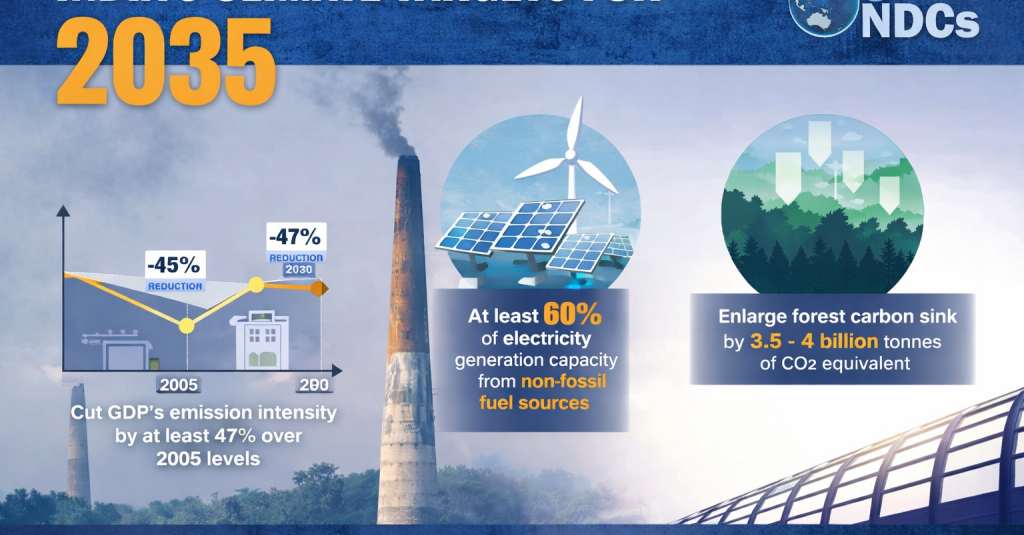
India has officially announced its Nationally Determined Contributions (NDCs) for the year 2035, marking a significant progression in its global climate commitments. Building upon the 2030 targets, the new roadmap pledges a 47% reduction in emission intensity of its GDP from 2005 levels and aims for 60% non-fossil fuel electricity capacity. This third installment of India’s climate strategy, mandated by the 2015 Paris Agreement, reinforces India's leadership in the Global South by balancing rapid economic growth with environmental responsibility.
The most striking upgrade is the shift toward 60% non-fossil fuel electricity generation capacity. Since India achieved its previous 50% target for 2030 nearly nine years ahead of schedule, the 2035 goal acts as an institutional driver for massive investments in solar, wind, and green hydrogen. However, the third pillar—carbon sequestration through forest cover—remains the most challenging. Expanding forest capacity to absorb 3.5 to 4 billion tonnes of CO2 requires not just plantation drives, but sophisticated land management and the protection of existing biodiversity. For aspirants, these NDCs are a case study in "Strategic Autonomy" in climate politics; India is fulfilling its Paris Agreement obligations of "progression" while ensuring that the scale of action remains "nationally determined" based on its unique socio-economic needs.
Nationally Determined Contributions (NDCs) are the heart of the Paris Agreement (2015). They embody efforts by each country to reduce national emissions and adapt to the impacts of climate change. A key rule under the agreement is the "Ratchet Mechanism," which requires countries to submit new, more ambitious NDCs every five years.
- 1st NDC (2015): Focused on 2025 targets.
- 2nd NDC (2022): Focused on 2030 targets (e.g., 45% emission intensity reduction).
- 3rd NDC (2026): Targets 2035 (e.g., 60% non-fossil fuel capacity).
- Net Zero Goal: India has committed to achieving Net Zero emissions by the year 2070.
- Panchamrit: The five-fold climate strategy announced by PM Modi at COP26 in Glasgow.
1. What is India’s target for reducing emission intensity of its GDP by 2035 compared to 2005 levels?
2. By 2035, India aims to have what percentage of its total electricity capacity from non-fossil fuel sources?
3. What does the acronym 'NDC' stand for in international climate negotiations?
4. Which year was the baseline for India’s emission intensity reduction targets?
5. India has committed to achieving 'Net Zero' emissions by which year?
6. The 2035 targets for forest carbon sink creation aim to absorb how many tonnes of CO2 equivalent?
7. Which international agreement legally binds countries to submit updated NDCs every five years?
8. What was the achieved reduction in India’s emission intensity by the year 2020?
9. The term 'Emission Intensity' of GDP refers to:
10. Under the Paris Agreement, NDCs must reflect a 'progression' over time. This is also known as:
11. India's first NDC was submitted in which year?
12. COP26, where the 'Panchamrit' strategy was announced, was held in which city?
13. Carbon Sequestration primarily involves which of the following?
14. India's second NDC, submitted in 2022, was targeted for which year?
15. What does 'Non-fossil fuel sources' of electricity include?