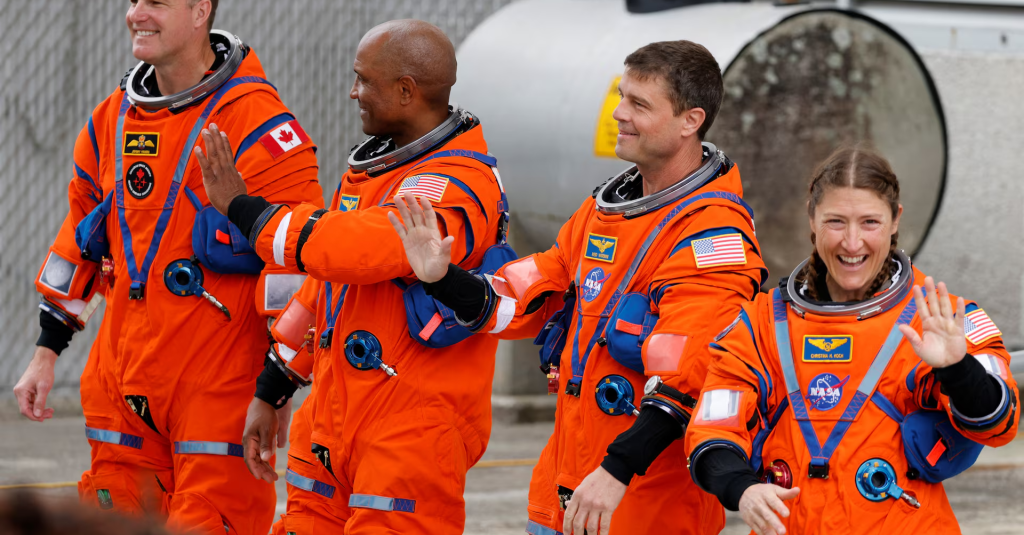
Artemis II: NASA's Historic Return to the Moon with Diverse Astronaut Crew
On April 1, 2026, NASA successfully launched the Artemis II mission, marking the first time a crewed spacecraft has ventured toward the Moon since the Apollo 17 mission in 1972. Carried by the powerful Space Launch System (SLS) rocket, the Orion spacecraft is transporting a diverse four-member crew on a 10-day flyby mission. This historic journey serves as a final "test-ride" to validate life-support and navigation systems in deep space, paving the way for a scheduled lunar landing in 2028.
Beyond the technical validation, the mission is a powerful symbol of inclusivity and international cooperation. The crew selection breaks long-standing barriers, featuring the first woman (Christina Koch), the first Black astronaut (Victor Glover), and the first non-U.S. citizen (Jeremy Hansen) to travel to the Moon's vicinity. This represents a fundamental shift from the Apollo era's geopolitical "Space Race" to a more collaborative "Artemis Generation" approach. For aspirants, it is essential to note that Artemis is not just about a single landing; it is about building the Gateway station and establishing a long-term lunar base. Success here provides the blueprint for the eventual human exploration of Mars, making the Moon the ultimate proving ground for deep-space survival.
NASA’s Artemis program, named after the twin sister of Apollo in Greek mythology, aims to establish a sustainable human presence on the Moon. The program follows the Apollo missions (1961–1972), which saw 12 humans walk on the lunar surface. Artemis utilizes a modern tech stack: the Space Launch System (SLS), the Orion crew capsule, and the future Lunar Gateway station.
- Artemis I (2022): Successful uncrewed mission to lunar orbit and back.
- Artemis II (2026): First crewed test mission (Lunar flyby).
- Artemis III (Target 2028): Planned mission to land the first woman and first person of color on the Moon.
- The Crew: Reid Wiseman (Commander), Victor Glover (Pilot), Christina Koch (Mission Specialist), Jeremy Hansen (Mission Specialist/CSA).
- Free Return Trajectory: The path Artemis II uses, where Earth's gravity naturally pulls the ship back home after circling the Moon.
1. Which rocket system is being used to launch the Artemis missions?
2. Who is the first woman scheduled to travel to the Moon's vicinity as part of the Artemis II mission?
3. Jeremy Hansen, a crew member of Artemis II, is a citizen of which country?
4. In Greek mythology, Artemis is the twin sister of which god?
5. What is the primary objective of the Artemis II mission?
6. Who was the first person to walk on the Moon during the Apollo 11 mission in 1969?
7. The Orion spacecraft's 'ECLSS' is critical for crew survival. What does 'ECLSS' stand for?
8. Victor Glover, the pilot of Artemis II, achieved what historic first for lunar missions?
9. How many days is the Artemis II mission expected to last?
10. Artemis II will circle the Earth twice before heading to the Moon. Why is this done?
11. The last human mission to land on the Moon was Apollo 17. In which year did it take place?
12. Which planned space station will serve as a hub for future Artemis missions to the lunar surface?
13. Who is the Commander of the Artemis II mission?
14. What is the name of the crew capsule used in the Artemis program?
15. In which year is NASA currently targeting the first crewed lunar landing of the Artemis program (Artemis III)?