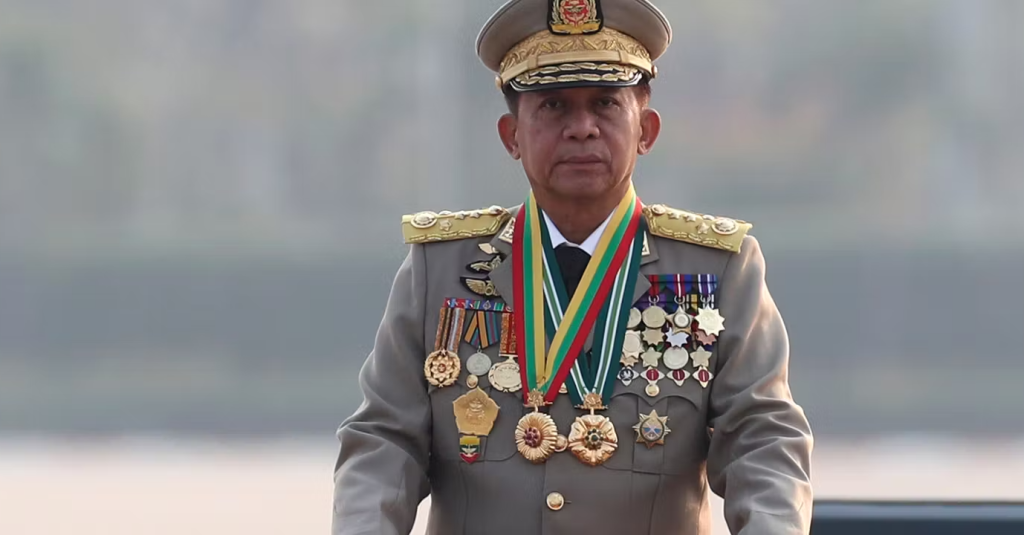
Myanmar's Junta Chief Min Aung Hlaing Becomes President Amid Controversy and ICC Arrest Warrant
On April 3, 2026, Myanmar’s military junta chief, Min Aung Hlaing, was elected as the President following a parliamentary vote. This move aims to formalize his authority as a civilian leader after five years of direct military rule. Hlaing, who has headed the armed forces since 2011, led the 2021 coup that ousted the democratically elected government. His presidency comes amid ongoing civil strife and intense international scrutiny, including an International Criminal Court (ICC) warrant related to the persecution of the Rohingya minority.
Internationally, Hlaing remains a pariah. The 2024 ICC move to seek an arrest warrant for crimes against humanity highlights the severity of the 2017 crackdown in Rakhine State. Statistical data indicates that over 740,000 Rohingya fled to Bangladesh in that year alone, joining hundreds of thousands already in exile. Currently, more than 1 million Rohingya reside in camps in Cox's Bazar, creating one of the world's largest refugee crises. For geopolitical observers, Hlaing’s "election" is seen as a scripted political maneuver designed to satisfy regional partners—such as some members of ASEAN—who have pushed for a return to a civilian-led roadmap, even if that leadership remains entirely controlled by the military establishment.
Myanmar (formerly Burma) has been under military influence for most of its history since gaining independence from Britain in 1948. The Tatmadaw (Military) yields immense power through the 2008 Constitution, which reserves 25% of parliamentary seats for uniformed officers.
- 2021 Coup: Triggered after the military alleged fraud in the 2020 elections won by the NLD.
- The Rohingya: An ethnic Muslim minority from Rakhine State, denied citizenship under Myanmar's 1982 Laws.
- International Criminal Court (ICC): Based in The Hague, it investigates individuals for genocide, war crimes, and crimes against humanity.
- ASEAN's 5-Point Consensus: The regional peace plan for Myanmar which includes an immediate end to violence and inclusive dialogue.
- Refugee Crisis: Over 1.2 million Rohingya are estimated to be displaced globally, with the majority in Bangladesh.
1. Who is the current President of Myanmar as of April 2026?
2. The Rohingya minority primarily originates from which state in Myanmar?
3. In which year did the military coup led by Min Aung Hlaing oust the democratically elected government?
4. Where is the International Criminal Court (ICC) headquartered?
5. Which country hosts the largest number of Rohingya refugees globally?
7. Aung San Suu Kyi is the leader of which political party?
8. What is the official name of the Myanmar military?
9. Approximately how many Rohingya refugees fled Myanmar during the 2017 military crackdown?
10. Myanmar is a member of which regional intergovernmental organization?
11. The 1982 Citizenship Law in Myanmar is controversial primarily because:
12. Which neighboring country did NOT share a border with Myanmar?
13. What is the name of the capital of Myanmar?
14. The term 'Tatmadaw' refers to which branch of the military?
15. Aung San Suu Kyi was awarded which international prize in 1991?