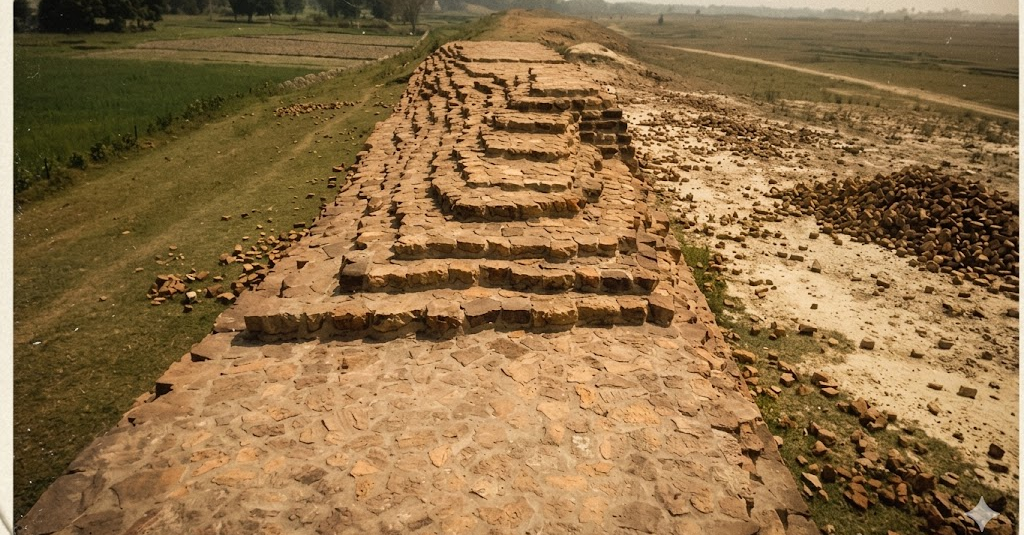
Excavation at Bihar's Fabled Balirajgarh, Gateway to Ancient Mithila: Explained
The Archaeological Survey of India (ASI) has officially commenced excavation at the historic site of Balirajgarh in Bihar's Madhubani district. Regarded as a site of immense mythological and historical value, Balirajgarh is traditionally believed to be the capital of the legendary King Bali. Beyond folklore, the excavation aims to uncover the site's role as a potential administrative epicenter of the ancient Videha Kingdom. This project is expected to provide critical archaeological evidence linking the site to the 16 Mahajanapadas and the cultural heritage of the Mithila region.
From a historical perspective, previous surface findings and limited digs have yielded Northern Black Polished Ware (NBPW), Sunga-period terracottas, and punch-marked coins, indicating a continuous settlement history spanning centuries. The current full-scale ASI operation seeks to determine the exact chronology of the fortification and its urban planning. For students, Balirajgarh serves as a prime case study in the intersection of "Itihasa" (myth-history) and archaeology. Proving its status as a major administrative hub would reshape our understanding of the Mithila region’s geopolitical importance during the 6th century BCE, offering a clearer picture of how the Mahajanapadas managed their peripheral territories and trade routes.
The Videha Kingdom: An ancient Indian kingdom during the Later Vedic period, which later became part of the Vrijji (Vajji) confederacy, one of the 16 Mahajanapadas. Mithila was its capital.
- Location: Balirajgarh is in the Madhubani district of Bihar, near the Indo-Nepal border.
- Mythology: Associated with King Bali and the Vamana (Dwarf) avatar of Lord Vishnu.
- Historical Era: Artifacts suggest occupation from the Mauryan, Sunga, Kushan, and Gupta periods.
- The 16 Mahajanapadas: Ancient Indian kingdoms (c. 600–300 BCE) mentioned in Buddhist (Anguttara Nikaya) and Jaina (Bhagavati Sutra) texts.
- ASI: The Archaeological Survey of India, founded in 1861 by Alexander Cunningham, falls under the Ministry of Culture.
1. In which district of Bihar is the archaeological site of Balirajgarh located?
2. Balirajgarh is believed to be the capital of which legendary mythological king?
3. The ancient Videha Kingdom was later part of which Mahajanapada confederacy?
4. Which type of distinctive pottery is typically associated with the urban phase of the Mahajanapadas?
5. Who was the founder of the Archaeological Survey of India (ASI) in 1861?
6. According to the Ramayana, who was the most famous philosopher-king of the Videha Kingdom?
7. The term 'Mahajanapada' literally translates to what?
8. Which Buddhist text provides the list of 16 Mahajanapadas?
9. The Mithila region is famous for which world-renowned traditional art form?
10. What is the approximate period associated with the 'Second Urbanization' in India?
11. The Vrijji (Vajji) confederacy was unique because it was a:
12. Which river is historically associated with the boundary of the Mithila/Videha region?
13. Balirajgarh is geographically close to the border of which neighboring country?
14. Archaeological evidence from Balirajgarh includes 'Punch-marked coins'. These are made primarily of:
15. Which of the following dynasties did NOT rule over the Mithila region in ancient times?