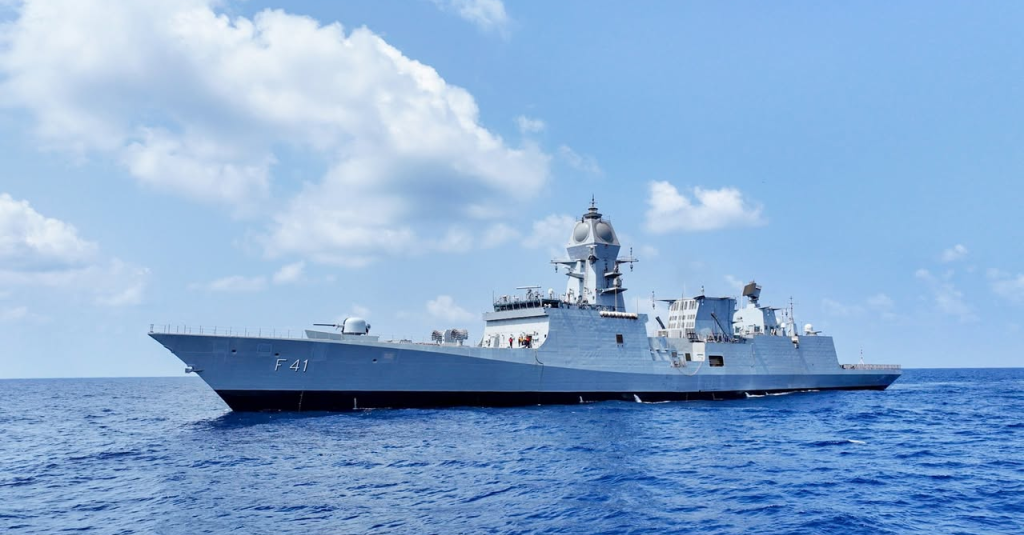
INS Taragiri Joins Indian Navy under project 17A: Explained
On April 3, 2026, the Indian Navy formally commissioned INS Taragiri at Visakhapatnam, marking a major milestone for Project 17A. Built by Mazagon Dock Shipbuilders Limited (MDL), this 6,670-tonne stealth frigate is the fourth of its class to join the fleet. Designed with advanced radar-evading technology and a lethal suite of indigenous weaponry including BrahMos missiles, INS Taragiri is engineered for multi-role operations, significantly enhancing India’s maritime superiority in the Indian Ocean Region.
The strategic importance of INS Taragiri lies in its versatility. It is not just a combat platform but a multi-role asset capable of air defense, surface warfare, and anti-submarine operations. Equipped with the supersonic BrahMos missile system and the Medium Range Surface-to-Air Missile (MRSAM) system, the ship can neutralize threats from hundreds of kilometers away. Furthermore, its ability to transition from high-intensity combat to humanitarian assistance and disaster relief (HADR) missions reflects the Indian Navy's role as a "first responder" in the Indo-Pacific. For aspirants, it is vital to note that Project 17A is a prime example of the 'Aatmanirbhar Bharat' initiative, showcasing that India has moved beyond assembling foreign designs to mastering the complex integration of modern weaponry, sonar, and radar technologies entirely on home soil.
Project 17A (Nilgiri-class): This project involved the construction of seven stealth frigates. These vessels are an improvement over the Project 17 (Shivalik-class) frigates, incorporating better stealth features, advanced weaponry, and high-tech sensors.
- The Builder: Constructed by Mazagon Dock Shipbuilders (MDL) and Garden Reach Shipbuilders & Engineers (GRSE).
- Weaponry: Features BrahMos (Surface-to-Surface) and MRSAM (Surface-to-Air) missiles.
- Stealth: Incorporates advanced hull design to minimize radar, thermal, and magnetic signatures.
- Nomenclature: Ships in this class are named after hill ranges in India (e.g., Nilgiri, Himgiri, Taragiri).
- Indigenous Content: Nearly 75% of the material and equipment is sourced from Indian industries.
1. INS Taragiri belongs to which class of Indian Navy warships?
2. Which primary shipyard built INS Taragiri?
3. What is the primary 'stealth' feature of the Project 17A frigates?
4. Which supersonic cruise missile system is integrated into INS Taragiri?
5. Project 17A ships are named after what features of India?
6. At which naval base was INS Taragiri commissioned into service?
7. Project 17A is a 'follow-on' to which previous warship class?
8. What is the displacement tonnage of INS Taragiri?
9. The MRSAM system used on INS Taragiri was developed jointly by India and which other country?
10. What is the approximate percentage of indigenous content in Project 17A ships?
11. Which ship was the lead vessel of the Project 17A class?
12. How many ships in total were ordered under Project 17A?
13. Which organization designed the Project 17A frigates?
14. What does the 'A' stand for in Project 17A?
15. Which weapon system is used for close-in protection against enemy missiles and aircraft?