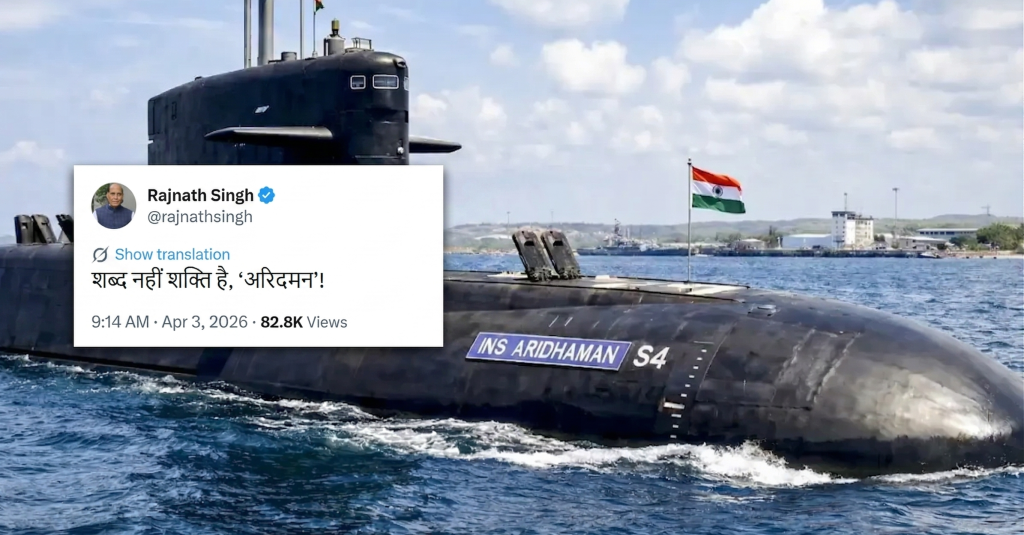
Deep Sea Deterrence-Commissioning of INS Aridhaman: Explained
On April 3, 2026, India significantly bolstered its maritime strike capability by inducting INS Aridhaman, its third nuclear-powered ballistic missile submarine (SSBN). Joining the elite ranks of INS Arihant and INS Arighaat, this 7,000-tonne vessel doubles the missile-carrying capacity of its predecessors. This induction solidifies India's sea-based nuclear deterrent, ensuring a robust "Second Strike" capability and placing India among a select group of nations possessing a fully operational nuclear triad.
Beyond the technical specifications, this achievement highlights India's growing self-reliance in high-end defense manufacturing. Developed under the Advanced Technology Vessel (ATV) project, the Arihant-class submarines are a testament to indigenous engineering. While India maintains a large fleet of conventional attack submarines for regional defense, the SSBNs are meant for strategic deterrence on a global scale. In an increasingly contested Indo-Pacific region, the ability to deploy three nuclear-powered submarines ensures that at least one is always on "deterrent patrol," maintaining a 24/7 strategic shield. This maturity in maritime nuclear capability sends a clear signal of stability and defensive resolve to the international community.
The **Nuclear Triad** consists of land-based ICBMs, air-launched missiles, and sea-based SLBMs. India achieved this status with the commissioning of INS Arihant. India’s submarine fleet is a mix of nuclear-powered SSBNs and conventional diesel-electric attack submarines (SSKs).
- The SSBN Lineup: INS Arihant (2016), INS Arighaat (2024), and INS Aridhaman (2026).
- Missile Systems: K-15 (Sagarika) with 750 km range; K-4 with 3,500 km range. The 'K' series is named after Dr. APJ Abdul Kalam.
- Nuclear Triad Club: USA, Russia, China, France, and India. (UK has sea-based only).
- Conventional Submarines: Includes 6 Kalvari-class (Scorpene) built at Mazagon Dock Shipbuilders Limited (MDL).
- No First Use (NFU): India’s doctrine formulated in 1999/2003, emphasizing "credible minimum deterrence."
1. What does the acronym 'SSBN' stand for in naval terminology?
2. How many vertical launch tubes does INS Aridhaman possess compared to its predecessor, INS Arihant?
3. The 'K' series of submarine-launched ballistic missiles (SLBM) is named after which Indian personality?
4. Which leg of the nuclear triad is considered most vital for a 'No First Use' policy country like India?
5. Which class of conventional submarines was built by Mazagon Dock in partnership with France's Naval Group?
6. What is the approximate strike range of the K-4 SLBM carried by INS Aridhaman?
7. India is part of a select group of countries with a nuclear triad. Which of the following is NOT a member of that group?
8. Under what project name were the Arihant-class submarines developed?
9. How many conventional (diesel-electric) submarines are currently in service with the Indian Navy?
10. When was INS Arihant, India's first SSBN, commissioned into the Navy?
11. The K-15 missile is also known by what name?
12. What is the approximate displacement tonnage of INS Aridhaman?
13. Which of the following is an attack submarine (SSN) rather than a ballistic missile submarine (SSBN)?
14. India's nuclear doctrine of 'Minimum Credible Deterrence' was officially adopted in which year?
15. What is the main advantage of a nuclear-powered submarine over a diesel-electric submarine?