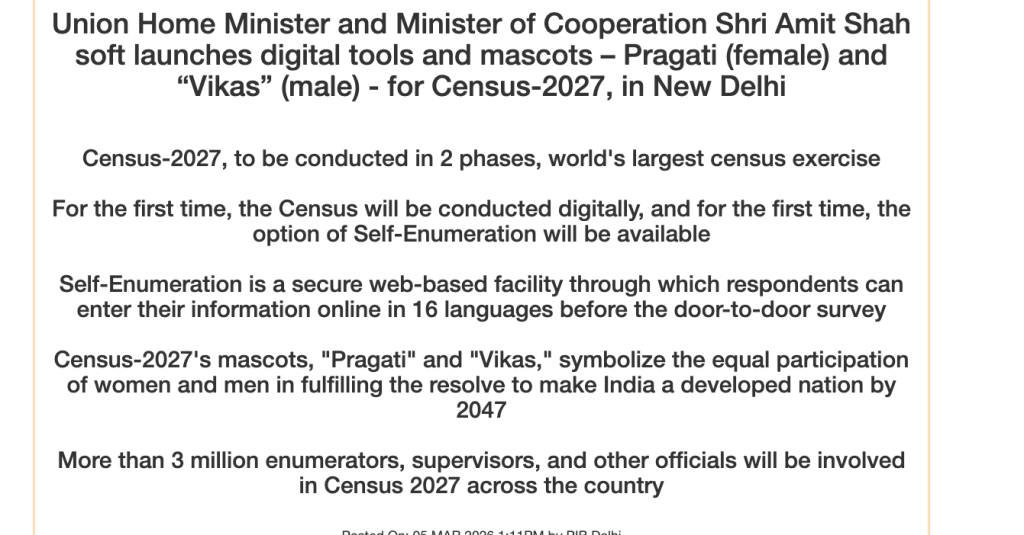
Census 2027 Kicks Off with Digital Self-Enumeration: Explained
The Government of India has officially launched the first phase of **Census 2027**, marking the start of the world’s largest administrative exercise. For the first time, the process includes a "self-enumeration" feature, allowing citizens to submit household data digitally via a portal or mobile app. This initial phase, scheduled between April and September 2026, focuses on Houselisting and Housing Census. In a significant social policy shift, the 2027 Census will recognize live-in couples in stable unions as married, while the much-anticipated caste enumeration is slated for the second phase in 2027.
Socially, the inclusion of stable live-in couples under the "married" category reflects the changing judiciary and societal landscape of modern India. Furthermore, the decision to conduct caste enumeration during Phase 2 (Population Enumeration) addresses long-standing demands for data-driven social justice. Phase 1 meticulously maps the quality of life—tracking amenities like internet access and cooking fuel—which will serve as the primary data source for central and state welfare schemes for the next decade. For aspirants, the key lies in understanding that Phase 1 is about "Assets and Infrastructure," while Phase 2 is about "People and Identity." This distinction is critical for understanding national planning and resource allocation.
The Census of India is governed by the Census Act of 1948. It is a decennial exercise, though the 2021 Census was delayed due to the COVID-19 pandemic, leading to the current 2027 cycle. The Registrar General and Census Commissioner of India, under the Ministry of Home Affairs, is responsible for conducting the exercise.
- Constitutional Status: Listed at Serial No. 69 in the Union List (Seventh Schedule).
- First Synchronous Census: Conducted in 1881 under W.W. Hunter (Lord Ripon's tenure).
- Digital Census: 2027 is the first Census to move from paper-pen to a Mobile App and Self-Enumeration.
- Phases: Phase 1 (Houselisting & Housing Census); Phase 2 (Population Enumeration).
- Excluded Zones: Phase 2 begins early (Sept 2026) in snow-bound areas of Himachal, Uttarakhand, and J&K.
1. Under which Schedule of the Indian Constitution is 'Census' listed as a Union Subject?
2. What is the primary focus of Phase 1 of the 2027 Census exercise?
3. In a first for Indian Census history, what category of couples will be counted as 'married' in 2027?
4. During which phase is the 'Caste Enumeration' scheduled to take place?
5. Which ministry is responsible for the conduct of the Census in India?
6. Who was the first Registrar General and Census Commissioner of independent India?
7. When was the first complete synchronous census conducted in India?
8. What is the designated window for self-enumeration before the first phase begins?
9. Which UT/State will undergo Population Enumeration early (September 2026) due to snow?
10. Under the self-enumeration mode, what must a citizen present to the physical enumerator?
11. Which of the following details is NOT collected during Phase 1?
12. How many years is the standard gap between two Indian Censuses?
13. The 2027 Census will use which primary device for house-to-house recording?
14. In Phase 2, fertility details are specifically collected for whom?
15. What is the name of the traditional method where an enumerator visits households?